As a kid, I was always fascinated by the art of telling stories. I fondly remember my class teacher who taught us topics like Indian Civilization, World War, Indian History and made me fall in love with the subject I hated the most.
Did she have a magical spell? Oh yes, she did… She was good at telling stories… She grabbed my attention by bringing life into the textbook characters.
Stories have defined our world. They have been with us since the dawn of communication, from cave walls to the tall tales recounted around fires. They have continued to evolve with their purpose remaining the same; to entertain, to share common experiences, to teach, and to pass on traditions.
What does story telling have to do with UX?
I have been practicing the language of story all through my journey as a designer and in this post I shall share my views and experiences using this mechanism in varied UX fields like research, conceptualization and identifying opportunities.
Story telling has a very evident role to play in various stages of UX Design.
The Research Phase
Use stories to narrate user behaviors
When you tell a story, you transform what you heard during research into data and information that your team can use to imagine opportunities and solutions.
One team member’s specific, descriptive and timely story can become shared knowledge and provide inspiration to the whole team. Because stories are accounts of real people, real situations and specific events (not general statements or summaries) they provide concrete details that help you address particular problems.
You could gather a team of designers and stakeholders in a room with white walls and post its. One team member starts with narrating the day in a life of a user he just interviewed. Others could gather observations, ideas and notes based on their individual interpretations of the story just told.
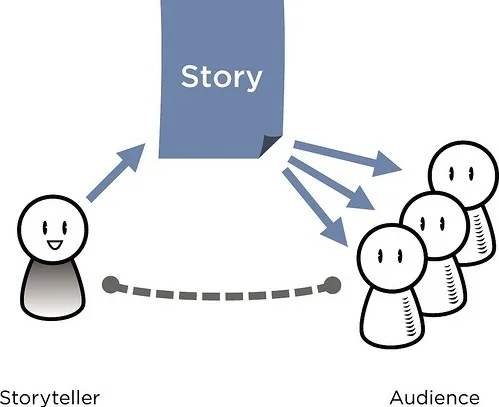
Book:Storytelling for User Experience , by Whitney Quesenbery & Kevin Brooks
The Conceptualization Phase
Use stories to identify opportunities
A story could be interpreted differently by different audiences. When you narrate a story to a team or a large group of audience, every person has his/her own perspective and idea of the story. This opens ways for different insights and opportunities for design.
For example, while narrating a story of a job seeker and his usage of a career portal it was observed that each participant / audience perceived the problem in a unique manner. The participant who was of nearly the same age as the persona could relate to the real life scenario in a much better manner and identified that lack of communication using technology was an area that needed to be further investigated whereas another group of participants felt that the persona was not bold enough to explore different channels to seek jobs. Hence he needed something simpler as job alerts via SMS.
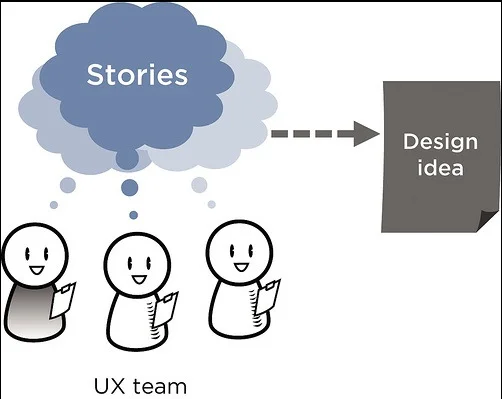
The best way to use stories for conceptualization is to jot down the story points in any favorable application and categorize the story points as “User Statement”, “Observation”, “Problem” and “Insight”.
Problems and Insights help you get closer to opportunities and Design Ideas
I use an excel spreadsheet to do this.
Book:Storytelling for User Experience , by Whitney Quesenbery & Kevin Brooks
The Implementation Phase
Use stories to communicate how design fits in the real world
The word implementation here means implementing your ideas and thoughts and making them concrete using prototypes and screen flows. It means giving a thought to screen navigations and creating working prototypes based on the research and conceptualization phase.
A story board could be an effective mechanism to communicate and relate the use of the designs and application in the life and context of the user. Using a story could help the product managers and stakeholders to effectively identify the areas where the proposed design could make a difference in the life of a user.
Indigo Studio is a very good tool to create storyboards.
Indigo Studio Storyboard example
Conclusion
It’s a good idea to incorporate the story centered design approach as UX designers. My experience has been rewarding and some key benefits are surely speeding communication, clarifying design goals, and collaboratively builds team design thinking.
Happy story telling!!